AI applications for clinical research, from first prototype to production.
My role
Staff AI/ML Engineer
When
2024 — present
Areas of work
LLM applications, agentic workflows, multimodal AI, mobile and AR/VR, software architecture, AI governance
AI/ML Rapid Development Studio
The Fortrea AI/ML Rapid Development Studio team.
The studio
Fortrea is a global contract research organization that runs clinical trials for pharmaceutical and biotechnology companies: about 5,900 trials in five years, with more than a million participants across roughly 100 countries. Its AI/ML Rapid Development Studio builds AI tools for the people who plan and run those trials.
As a Staff AI/ML Engineer, I take ideas from the first prototype to production. I built and led the real-time budget estimator for multimillion-dollar trials, from the ML model to the React and Python application that surfaces it. I’ve also conceived and led delivery of AI-augmented tools for clinical, commercial, and marketing teams, including authoring tools, multimodal content generation, and agentic workflows that work across internal systems, and I’m a co-inventor on two published patent applications from that work.
I also help decide how AI reaches production across the company. I represent AI for Clinical Platforms on the Architecture Review Board and advise the AI Governance Committee.
An exploratory data platform, from requirements to production, against an estimated year
Under 8 weeks
A workflow shortened by one of the AI-augmented tools I led
Days → minutes
Representing AI on the Architecture Review Board, and advising the AI Governance Committee
AI governance
Patent applications
Fortrea filed patent applications on two pieces of my work, and both are now published with me as a named co-inventor. Neither claims to have invented retrieval or OCR; each covers a specific way of combining them.
I had Claude Opus 5.5 in Claude Code create the animations below from the information in the publicly available applications.
Co-inventor · First filed December 10, 2024 · Published June 11, 2026
Artificial intelligence (AI) guidance software for document drafting
Retrieval is the easy part of AI writing help; trust is the hard part. In this design, every suggestion is checked against the guidance passage it came from, such as a regulation or a benchmark contract, and suggestions like ones people have already rejected are filtered out before anyone sees them.
Chunk and embed
The draft is split into chunks, and each chunk is turned into an embedding.
Match guidance
Each chunk is compared with embedded guidance documents to find the most similar passages.
Prompt the model
The draft chunk, the matched guidance, and a fixed instruction go to a language model, which suggests improvements.
Check the source
Each suggestion is validated against the guidance it came from.
Learn from feedback
People accept or reject suggestions, and new ones similar to rejected suggestions are filtered out.
Animation created with Claude Opus 5.5 in Claude Code from the publicly available application. Not a screenshot of Fortrea software.
Co-inventor · First filed November 11, 2024 · Published May 21, 2026
Dynamically populating a webpage in real time with content from a captured image
Getting what’s on paper, or on another screen, into a web form. A phone pairs with the page by scanning a QR code, photographs the document, and the extracted content lands in the form’s fields live, without a reload.
Scan to pair
The phone scans a code on the webpage that identifies the page’s open connection.
Capture
The phone photographs a document, such as a printed table, and sends the image with that identifier.
Extract
A model on the server pulls the content out of the image.
Fill in place
The server sends the content to the paired page, and its fields update without a reload.
Animation created with Claude Opus 5.5 in Claude Code from the publicly available application. Not a screenshot of Fortrea software.
Most of the studio’s work is internal. In August 2025, Fortrea described some of it publicly: productivity tools it had begun deploying, and the larger projects they lead toward.
01
Real-time budget estimation
An AI-powered productivity tool that produces budget estimates in real time.
02
Risk-based quality management
A model that identifies when a monitoring visit is needed, given current performance trends.
03
Digital CRA
An agentic AI approach to a mobile application for clinical research associates, alongside a resource management tool.
04
An intelligence layer
Core models over clinical and operational data, built to give teams connected, real-time insight from daily trial execution to enterprise strategy.
05
AI-enabled feasibility
Tools that bring AI to feasibility, the early work of judging where and how a trial can run.
06
FluSync
A conceptual tool that brings WHO, CDC, and ECDC disease-surveillance data into trial operations.
Fortrea launched the studio in 2024 to partner with customers on bespoke technology, build new technology, and improve existing operations. Its remit runs across AI/ML, mobile applications, and AR/VR.
It works as a balanced team, so a prototype gets looked at from every side before it goes further.
One shared product problem
Product & design
The problem we choose and the experience we prototype.
Data, AI/ML & engineering
Data science, machine learning, and software engineering working through the technical approach together.
Domain expertise
Clinical, operational, and educational experts connecting the work to real settings.
Staff level, hands on
I build working prototypes early, so the team has something concrete to try with the people who will use it, then carry what holds up into architecture, implementation, and release. I keep writing code throughout.
Prototype
Working software early, to test an idea before committing to it.
Architecture
The technical approach, its trade-offs, and a plan for operation and maintenance beyond the prototype.
Agentic workflows
Agents that plan steps and act across enterprise tools, data, and documents, built with guardrails, human review, and evaluation.
Delivery
Dependencies, milestones, and releases with engineering partners, alongside my own code.
Standards and hiring
I help set technical standards for the studio’s work and interview candidates for the team.
Mentorship
I mentor engineers through code review, pairing, onboarding, and regular 1:1s, and help colleagues outside engineering learn to work with AI.
Governance
I represent AI for Clinical Platforms on the Architecture Review Board, working with cybersecurity on data, access, model deployment, and vendor reviews, and advise the AI Governance Committee.
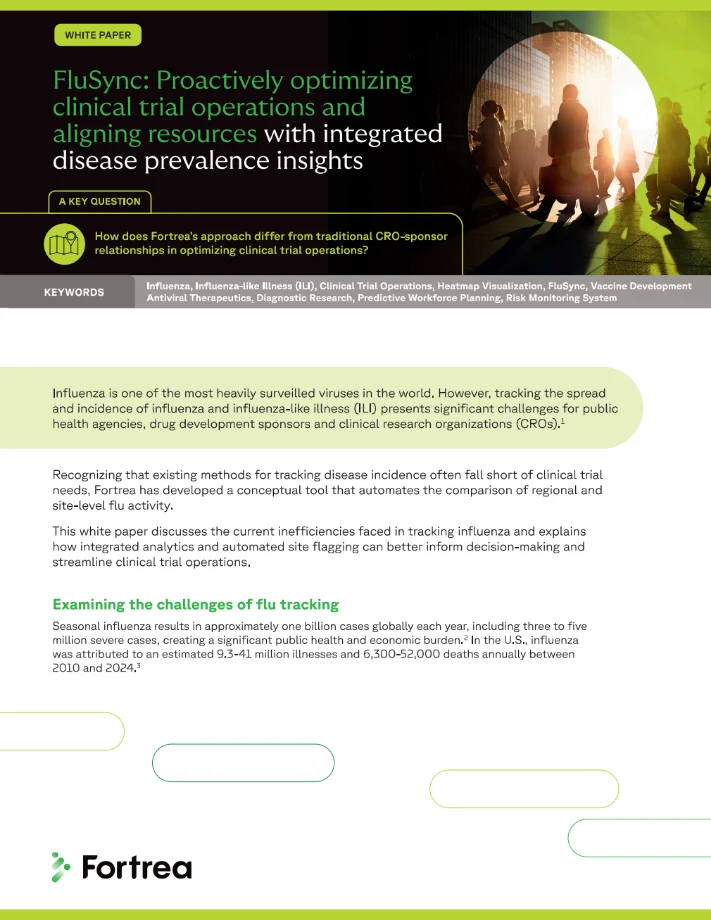
FluSync whitepaper
Whitepaper · 2026 · 4 pages
FluSync
Proactively optimizing clinical trial operations and aligning resources with integrated disease prevalence insights
FluSync explores how disease surveillance and site-level data can guide clinical trial operations. It brings WHO, CDC, and ECDC data into comparative views and follow-up workflows. The paper describes a conceptual tool and simulation.
I contributed to this paper as part of the AI/ML Rapid Development Studio and am credited in its acknowledgments.
Dates from public sources: Fortrea’s announcements and the published patent applications.
June 2024
The studio launches
Fortrea announces its AI Innovation Studio. The technologies it names include specialized language models, symbolic AI, mixed reality, predictive analytics, and digital twins.
 Henry Kobin